 Practical information
 Authorizations and regulations
 Documentation
 Around the abbey
 Contact
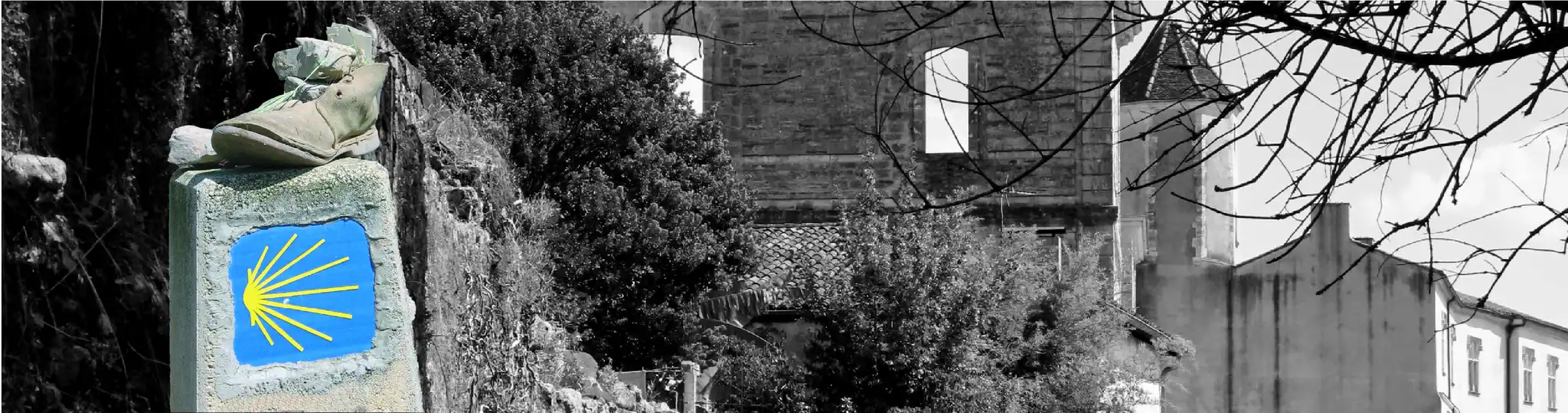
Since 1998, the Abbey of Saint-Jean de Sorde has been on the Unesco World Heritage List as part of the Pilgrimage Route to Santiago de Compostela in France. It is an important stop on the pilgrimage route to Tours and an essential place to visit for pilgrims who are welcomed in a communal refuge.

The Pilgrimage Routes to Santiago de Compostela in France : a serial cultural property
The site Pilgrimage Routes to Santiago de Compostela in France is inscribed on the World Heritage List as a selection of 71 monuments and 7 sections of pathway that bear witness to the spiritual and material aspects of the pilgrimage. Each of these 78 components contributes to the value of the site as a whole by providing a part of significance. Only this ensemble, as such, justifies inscription on the World Heritage List, which implies a joint management supported by a network of owners and managers around a shared project.
These 78 buildings and sections of paths are spread over 10 regions and located on different routes.
In the Landes, Sorde Abbey, on the Tours route or via Turonensis, shares this international recognition with three other sites :
the bell tower-porch of the ancient church of Mimizan - coastal route,
the abbey of Saint-Sever - Vézelay route or via Lemovicensis
the church of Sainte-Quitterie in Aire-sur-Adour - Le Puy route or via Podiensis.
The Abbey of Sorde is a member of the French Agency of the Ways of Compostela.
An outstanding universal value
Throughout the Middle Ages, Santiago de Compostela was a major destination for countless pilgrims from all over Europe. To reach Spain, pilgrims crossed France. Four symbolic routes from Paris, Vezelay, Le Puy and Arles to the Pyrenees summarise the countless routes taken by travellers. Pilgrimage churches or simple sanctuaries, hospitals, bridges, and crosses mark these routes and bear witness to the spiritual and material aspects of the pilgrimage. Spiritual exercise and manifestation of faith, pilgrimage also affected the secular world by playing a decisive role in the birth and circulation of ideas and the arts.
Extract from the Retrospective Declaration of Outstanding Universal Value adopted by the World Heritage Committee
(Krakow, 2017)
Criteria for inscription :
The pilgrimage route to Santiago de Compostela played an essential role in religious and cultural exchanges and development during the late Middle Ages, as is admirably illustrated by the carefully selected monuments along the piligrimage routes in France.
The spiritual and physical needs of pilgrims travelling to Santiago de Compostela were eased by the creation of a number of specialised buildings, many of which were created or further developed on the French sections.
The pilgrimage route to Santiago de Compostela is an exceptional testimony to the power and influence of the Christian faith in all social classes and countries of Europe in the Middle Ages.
The convention
The World Heritage Convention is an international treaty concluded in 1972 between States and the United Nations Educational, Scientific and Cultural Organization (UNESCO). It defines the natural or cultural sites that deserve to be inscribed on the World Heritage List.
The heritage inscribed on the World Heritage List represents an invaluable and irreplaceable asset for each nation, but also for the whole humanity. Its preservation is an important factor in maintaining the richness and diversity of human cultures and their environment. Action in favour of heritage is part of UNESCO’s approach to promoting a spirit of peace through dialogue between people, beyond their differences.
By signing this convention, France has made a commitment to the international community to protect, conserve and enhance the world heritage sites located on its territory and to cooperate internationally to help safeguard the heritage.
In 2022, France had 49 properties inscribed on the World Heritage List : 42 cultural properties, 6 natural properties ans one mixed property out of their 1 157 properties on the World Heritage List..
A European cultural route
In 1987, the Saint James Way inaugurated the Council of Europe's European Cultural Routes programme. These Cultural Routes demonstrate, through the journey through time and space, that the heritage of different European countries contributes to the common cultural heritage and implements the values of the Council of Europe : human rights, cultural diversity, intercultural dialogue and mutual exchange across borders.
European Federation of Saint James Way

Sorde Abbey, located on the Tours route, is an essential milestone in the discovery of the pilgrimage heritage in the Landes.
A local pilgrimage centre in the Middle Ages, Sorde Abbey attracted pilgrims who came to pray near the treasure of relics kept in its abbey church. It was also a major stopover for pilgrims before the often perilous crossing of the Gave d’Oloron, as evidenced by Book V of the Codex Calixtinus, written in the 12th century to the glory of saint James. The abbaey also had a hospital built stradding the way, l'Espitaou, to ensure the care and hospitality of the poor and pilgrimsA local pilgrimage centre in the Middle Ages, Sorde Abbey attracted pilgrims who came to pray near the treasure of relics kept in its abbey church. It was also a major stopover for pilgrims before the often perilous crossing of the Gave d’Oloron, as evidenced by Book V of the Codex Calextinus, written in the 12th century to the glory of Saint James. The abbaey also had a hospital built stradding the way, l'Espitaou, to ensure the care and hospitality of the poor and pilgrims.
Today, the village maintains the tradition of hospitality by welcoming pilgrims of all nationalities in a 3-star gîte !
The roads to Compostela in New Aquitaine and in the Landes
It is in our region, at the gateway to Spain, that the four main current routes to Santiago converge. With 26 monuments and a section of the route inscribed on the UNESCO World Heritage List, these routes are an essential part of New Aquitaine.
The crossing of the Landes on the Tours route-GR®655 extends over 150 kilometres and takes pilgrims from the village of Le Muret to Sorde-l’Abbaye, passing through Moustey, Labouheyre, Onesse-et-Laharie, Lesperon, Taller, Gourbera, Saint-Paul-les-Dax and Dax.
Of the four Grande randonnée trails leading to Santiago de Compostela, the GR®655-Via Turonensis is the most notherly. Starting in Brussels, the northern part of the route was mainly used by people from the north and north-east of Europe to reach the famous shrine of saint-Martin de Tours. The route passes through basilicas, such as those of Saint-Quentin and Saint-Denis, and the most famous cathedrals : Noyon, Senlis, Paris, Chartres, Orléans and Tours
After Dax and Saint-Pandelon, the Pays d’Orthe and Arrigans area marks the last stages of the Landes region before entering the northern Basque country towards Saint-Jean-Pied-de-Port. Between Saint-Palais and Saint-Jean-Pied-de-Port, the Tours route-GR®655 joins the Vézelay route-GR®654, then the Puy route-GR®65 and finally the Piedmont route-GR®78. The crossing of the Pyrenees is made by the Roncevaux pass following the end of the Le Puy route-GR®65.
Accomodations for pilgrims in Pays d’Orthe et Arrigans
The route chosen by the Société landaise des Amis de Saint-Jacques et d’études compostellanes (Landes Association of Saint James'Friends and Compostela Studies) passes through Cagnotte, then Saint-Cricq-du-Gave and Sorde-l’Abbaye, three villages that welcome passing pilgrims in their gîtes. The deviation via Peyrehorade does not pass through Sorde l'Abbaye.
CAGNOTTE
Refuge de l'abbaye - Chemin de Compostelle - 40300 Cagnotte
Learn more :
SAINT-CRICQ-DU-GAVE
Gîte du pèlerin - 74 rue du Barrail - 40300 Saint-Cricq-du-Gave
Learn more :
les détails du gîte
un peu d'histoire
SORDE-L'ABBAYE
Gîte jacquaire - 92 rue Juzan - 40300 Sorde-l'Abbaye
Learn more :
les détails du gîte
un peu d'histoire
To learn more :
L'Agence française des Chemins de Compostelle :
4 rue Clémence Isaure
31000 Toulouse
Tel : 05 62 27 00 05 - www.chemins-compostelle.com
La Société landaise des Amis de Saint-Jacques et d'études compostellanes :
2 rue Augustin Lesbazeilles
40000 Mont de Marsan
Tel : 05 58 93 38 33 - www.compostelle-landes.org
Les amis du chemin de Saint-Jacques de Compostelle dans les Pyrénées-Atlantiques :